
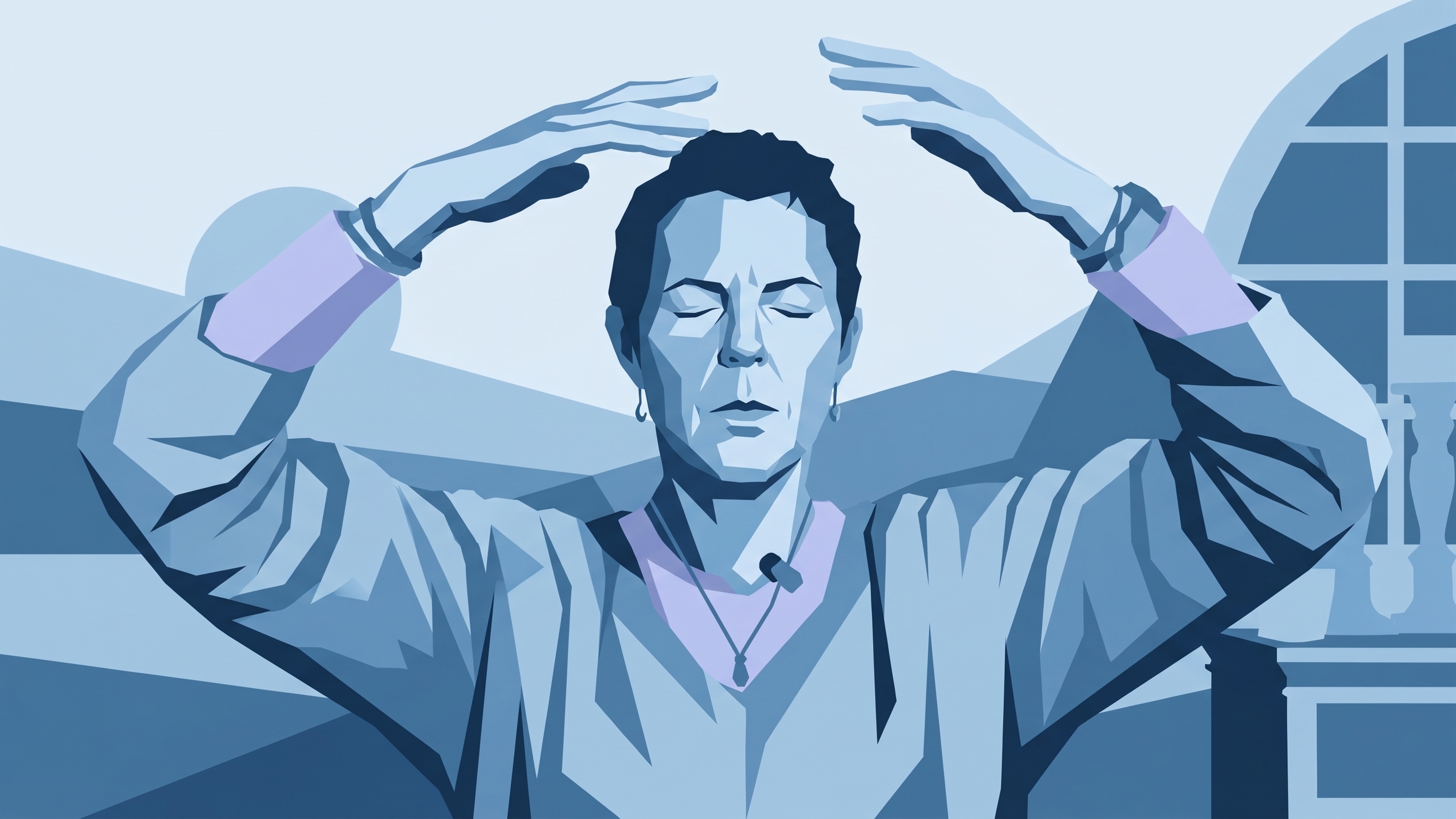
What happens when we change our relationship with illness, develop a consistent Qigong practice, and begin to explore the connection between consciousness, intention and Qi?
In the Wisdom Qigong Uncovered podcast, people from around the world share deeply personal stories of illness, healing and transformation through Zhineng Qigong. Their experiences are different, but each story highlights a common thread: healing is not only about what we do physically. It can also involve how we think, what we focus on, how consistently we practise, and how we relate to ourselves and the Qi field.
The following four stories offer a glimpse into these different approaches to Zhineng Qigong and the principles that shaped each person's journey.
Yvette Martin: Finding Hope Beyond a Diagnosis
Yvette Martin's healing journey began with breast cancer in 2020. After undergoing chemotherapy, surgery and radiation, she was declared cancer-free. Two years later, however, the cancer returned as a lesion in her cerebellum.
Following surgery, the cancer returned again. This time, it affected her vagus nerve and vocal cords. She lost her voice, struggled to swallow solid food, lost significant weight and experienced paralysis in her right shoulder and arm. Doctors considered her condition terminal and sent her home with only weeks to live.
Yvette was offered another high-risk surgery, but she decided not to proceed. Instead, she attended a 10-day Zhineng Qigong retreat in Gold Coast, Australia.
She later travelled to China three times and Thailand for further training and healing work. Her practice became a major part of her daily life.
From practising a method to connecting with Qi
Yvette practised for hours at a time, both independently and with groups. She consciously connected with the global Zhineng Qigong community, Dr Pang Ming and the Qi field.
During one retreat, she experienced what she described as a strong Qi reaction involving shaking and sweating. Rather than viewing practice as another task she had to complete, something began to change in her relationship with it.
Qigong became less about forcing an outcome and more about joy, connection and trust.
According to Yvette's account, her voice began returning during the retreat. Over the following months, her swallowing improved, she regained weight and movement gradually returned to her right arm.
Her story raises an important question: what happens when we change not only what we do, but also how we relate to fear, hope and the possibility of healing?
Benjamin Schiess: The Importance of Acceptance
Benjamin Schiess lived with pemphigus foliaceus, a rare autoimmune condition, for approximately ten years. His skin was extremely sensitive, and even restorative yoga could be difficult.
Medical treatment helped manage his condition, but he was also concerned about the potential long-term effects of the medication.
Benjamin eventually attended a six-day Zhineng Qigong workshop in Israel.
After the workshop, he began practising for approximately one to one-and-a-half hours each day. He developed a routine that incorporated different Zhineng Qigong methods, including Levels 1, 2 and 3.
Changing the direction of the mind
For Benjamin, one of the most significant changes was learning how to direct the mind.
Instead of allowing his thoughts to become consumed by fear and illness, he began giving his mind something constructive to focus on. He explored different parts of his body through his practice, including his shoulders, heart, digestion and breathing.
But perhaps the most important shift was acceptance.
Rather than constantly fighting against the reality of his condition, Benjamin began accepting where he was and redirecting his attention towards health and practice.
He described this as changing the direction of the mind's creative power.
Over time, Benjamin reported significant improvements. Within several weeks, he was able to stop taking antibiotics, and he experienced a reduction in attacks. Over the following years, he gradually reduced his steroid medication and eventually reported becoming medicine-free.
His experience highlights an important principle in Zhineng Qigong: acceptance does not necessarily mean giving up. Instead, acceptance can create space to redirect our energy and attention.
David Ho: Consistency and Intention
David Ho's story began with a serious health event in 2016. After spending two weeks in intensive care because of critically low sodium levels, he later developed problems with his right eye.
He was diagnosed with dry macular degeneration and was told that his vision could progressively worsen.
David, who came from an engineering and military background, approached his practice with the same discipline he had developed throughout his life.
He connected with Zhineng Qigong teacher Britta and began practising early in the morning, often for one to two hours, as well as in the evening.
From mechanical movement to feeling Qi
In the beginning, David focused on practices such as Lift Qi Up and Pour Qi Down and Three Centers Merge Standing Meditation. Later, he incorporated Level 2 Body and Mind Method and La Qi.
Over time, his experience of the practice changed.
Rather than simply performing the movements mechanically, he began paying greater attention to the sensation of Qi. He described experiencing warmth and a sense of Qi around his eyes.
His practice became less about simply completing exercises and more about developing awareness and connection.
During the COVID period, a scan reportedly showed significant peripheral vision loss in his right eye. David continued practising, attending online training and workshops and maintaining his daily routine.
Later, another scan reportedly showed that his peripheral vision had returned.
David's story also highlights something beyond the physical practice: the importance of making your own health a priority.
He came to see his daily Qigong practice as something as normal as brushing his teeth. Even on days when he felt tired and did not feel like practising, he noticed that those were often the days when he most needed to do it.
For David, intention and consistency became part of his way of life.
Richard Clegg: Moving From Fear to Intention
In January 2018, Richard Clegg experienced an ocular migraine that led to the discovery of a 9mm malignant melanoma behind his right eye.
He was told that there was a serious risk of the cancer spreading and was offered removal of the eye.
Richard decided that he did not want fear to determine his outlook. He underwent localized radiation treatment and later travelled to Hawaii to learn Zhineng Qigong and Hunyuan Qi Therapy.
Working with intention
Richard approached his practice with a strong sense of intention.
Rather than constantly identifying himself with his diagnosis, he consciously separated himself from it. He described speaking directly to the tumour and affirming that it was no longer wanted in his body.
He practised La Qi for many hours each day and worked with specific eye practices within the Qi field.
According to Richard's account, follow-up imaging showed a rapid reduction in the size of the tumour, followed later by what doctors identified as scar tissue. His medical team reportedly found the rate of change surprising.
But his story was not only about the physical outcome.
Richard described a deeper internal transformation from fear of death towards love and a greater appreciation for life.
During his time in Hawaii, he also began exploring emotional patterns that he associated with his healing journey, including anger, frustration and feeling stuck.
For Richard, Zhineng Qigong became a way of working with both the physical and emotional dimensions of his experience.
What These Four Zhineng Qigong Healing Stories Teach Us
Although Yvette, Benjamin, David and Richard experienced very different health challenges, several themes appear throughout their stories.
1. Consciousness and intention
A central principle in Zhineng Qigong is often expressed as:
Mind Directs, Qi Follows.
The intention behind a practice matters.
Rather than simply moving the body, practitioners learn to use consciousness to guide attention and intention. This can change the way we experience a practice and the way we relate to our body.
For these four practitioners, intention took different forms. For Yvette, it involved moving beyond fear and connecting with the Qi field. Benjamin focused on redirecting his mind rather than constantly fighting his illness. David developed a clear intention around his health and practice. Richard consciously changed the way he related to his diagnosis.
2. Consistent practice
None of these stories centres on a single practice session.
Each person developed a relationship with Zhineng Qigong that extended beyond occasional practice.
David's story particularly highlights how consistency can turn practice into a natural part of everyday life. Benjamin developed a daily routine. Yvette practised for extended periods and continued learning internationally. Richard committed significant amounts of time to his practice.
Consistency does not necessarily mean practising for hours every day.
It can begin with creating a regular space for yourself and returning to that practice again and again.
3. Connection to the Qi field
Another recurring theme is connection.
Zhineng Qigong teaches that Qi is not something isolated within the individual. Practitioners learn to experience themselves as part of a greater Qi field.
For Yvette, this connection became particularly important. She described the Qi field as something universal rather than limited to a particular location.
Practising with others, attending retreats, learning from teachers and connecting with the wider Zhineng Qigong community can all support this sense of connection.
Healing Is More Than a Physical Practice
These stories invite us to look at Zhineng Qigong from a broader perspective.
The practice is not simply a series of physical movements.
It also involves consciousness, intention, attention, consistency and our relationship with the Qi field.
This does not mean that Zhineng Qigong should replace medical diagnosis or treatment. Every person's health journey is unique, and the experiences shared in these stories are individual experiences rather than guarantees of a particular outcome.
What these stories can offer is inspiration to explore a different relationship with your own health and well-being.
You do not need to begin by practising for hours.
You can start with a few minutes.
Become aware of your body. Quiet the mind. Bring your attention into the present moment. Practise with clear intention. Then return to it tomorrow.
Over time, these small moments of practice can become part of a deeper journey of self-cultivation.
Begin Your Own Zhineng Qigong Journey
The stories featured in Wisdom Qigong Uncovered remind us that every healing journey is personal.
There is no single experience of Zhineng Qigong, and no single path that looks the same for everyone.
What we can do is become curious.
Curious about our consciousness. Curious about our intentions. Curious about our relationship with Qi. And curious about what may change when we practise consistently.
At the Zhineng Qigong Students Hub, you can explore guided practices, teachings and resources designed to support you at different stages of your Qigong journey.
Start where you are. Practise what you can. Stay curious about what is possible.
Watch the Full Healing Stories
Hear each journey in full on the Wisdom Qigong Uncovered podcast. Scroll through the episodes below.